January 27, 2026
WNY Health Center Leaders Call for Increased NYS Investment in Health Centers
Health center leaders from across the region stand together to address financial concerns.
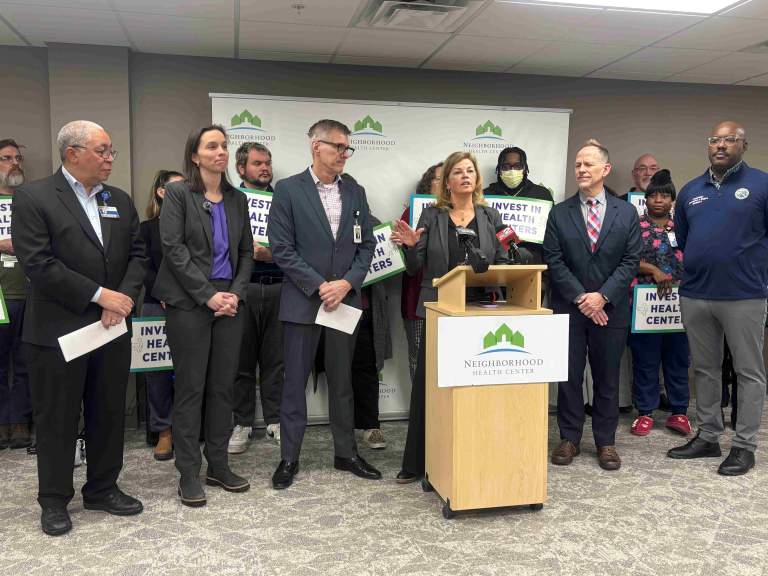
Leaders from Neighborhood Health Center, Jericho Road Community Health Center, Universal Primary Care, Community Health Center of Buffalo, and Evergreen Health came together on Tuesday, January 27, to urge Governor Kathy Hochul and state lawmakers to invest in health centers. These five Western New York health centers are members of the Community Health Care Association of New York State (CHCANYS), and they gathered together on Tuesday at Neighborhood Health Center Mattina, 300 Niagara Street, to show solidarity with health centers all across the state. This event in Buffalo was part of a series of regional health center advocacy actions taking place across New York State as decisions are being made leading up to the April 1 New York State budget deadline.
Health centers across the state are facing a growing financial crisis. Federal policy changes threaten health insurance coverage for up to 1.5 million New Yorkers, many of whom are expected to turn to health centers for care when they lose their insurance coverage. Health centers do not turn away people without insurance, but the health centers will not be reimbursed for caring for these patients — resulting in an estimated $300 million revenue shortfall statewide.
“Neighborhood Health Center alone cares for nearly 34,000 Western New Yorkers,” said Neighborhood Health Center President and CEO Joanne Haefner. “Health centers help patients have better health outcomes, and we’re a smart investment. Independent analyses have consistently found health centers reduce health system costs by avoiding unnecessary emergency room visits, hospitalizations, and preventable complications of chronic disease. Yet there has been an underinvestment in health centers.”
(Hear more from Joanne: click here)
While the governor's proposed budget includes $40 million for health centers, it falls far short of the $300 million investment needed.
“Universal Primary Care is happy to see good support for health centers in the governor’s newly released budget. However, health centers are working with Medicaid reimbursement rates that haven’t been updated for 25 years to reflect the cost of providing care to our over 14,000 rural patients in Allegany and Cattaraugus Counties,” said Universal Primary Care CEO Brett Lawton. “We must have bigger investments into health centers to help us keep our doors open to serve our communities that count on us!”
“Community health centers like Jericho Road play a vital role across the state by serving patients regardless of insurance status or ability to pay,” said Jericho Road CEO Dr. Allana Krolikowski. “Our New York Governor and Legislature must ensure that community health centers have the support needed to continue delivering care that protects both public health and our most vulnerable neighbors.”
"Community health centers don’t just care for patients – we also employ people across Western New York," said Community Health Center of Buffalo Chief Operating Officer Alfred Hammonds. "When our staff care for our patients, it’s personal. Stable, ongoing funding means continuous, high-quality care, stable jobs, and stronger communities.”
Health centers serve patients at nearly 900 sites statewide, providing primary and preventive care including medical, dental, behavioral health, vision, and substance use disorder services to more than 2.5 million people each year; that’s 1 in 8 New Yorkers. Health centers are located in neighborhoods where people might not otherwise have a primary doctor’s office. Health centers welcome everyone who walks through their doors, even if they don’t have insurance or the ability to pay.
“We hear lawmakers talk a lot about protecting the safety net. Well, here’s your chance,” said CHCANYS President and CEO Rose Duhan. “We need you to make a transformational investment in community health centers to ensure the safety net survives. Can we count on you?”
Community health centers are economic engines, but they have been underfunded for decades. Medicaid is their single largest source of income, representing 42% of total health center revenue. Yet New York’s outdated Medicaid reimbursement system, unique to health centers, pays rates based on costs from a quarter of a century ago, putting health centers at a disadvantage as they deal with rising costs, workforce shortages, and growing demand. CHCANYS represents all community health centers in New York State. This year, it is advocating for the following:
● Invest $300M in health centers to strengthen the state’s health care safety net, keep doors open, and protect jobs. This is an opportunity for New York State to showcase its commitment to community health and health care access for every New Yorker while demonstrating fiscal responsibility.
● Protect the 340B prescription drug program (A.6222 Paulin/S.1913 Rivera), which is a federal program that allows health centers to reinvest millions of dollars in prescription drug cost savings into their communities at zero cost to taxpayers or the government.
● Protect patients’ access to telehealth by ensuring health centers receive full payment for telehealth services.
● Allow medical assistants to vaccinate, freeing up other caregivers to work at the top of their license while allowing community health centers to keep their communities healthy.
CHCANYS’ Legislative Agenda briefing book provides additional information, and State fact sheets provide a breakdown of the types of care health centers provide and how they are funded.